Image: Justin Sullivan/Getty Image News via Getty Images
Congress is approaching a defining moment for the future of America’s transportation system.
This year, Congress must pass legislation to reauthorize the nation’s transportation programs—deciding how hundreds of billions of federal dollars are spent on roads, transit, and other transportation infrastructure. These decisions shape household costs, public safety, and climate pollution—and the current law expires this year. Now Congress must decide whether the next Surface Transportation Reauthorization will build on that progress or move the country backward.
At a time when families are struggling with rising costs—and when transportation remains the largest source of climate pollution in the U.S. economy—lawmakers face a clear choice: invest in cleaner, safer, more affordable transportation, or double down on policies that lock in higher costs and higher pollution.
Yet instead of advancing solutions that lower costs and cut pollution, Republicans in Congress are proposing new consumer taxes on electric vehicles (EVs).
To understand what these proposals would actually mean for pollution, consumers, and the economy, Evergreen modeled several potential legislative actions that represent both opportunities and risks in the upcoming surface transportation reauthorization debate. The results are stark.
One thing is clear: there is no such thing as a “fair” EV fee.
EV Fees Would Drive a Massive Surge in Climate Pollution and Slow EV Adoption
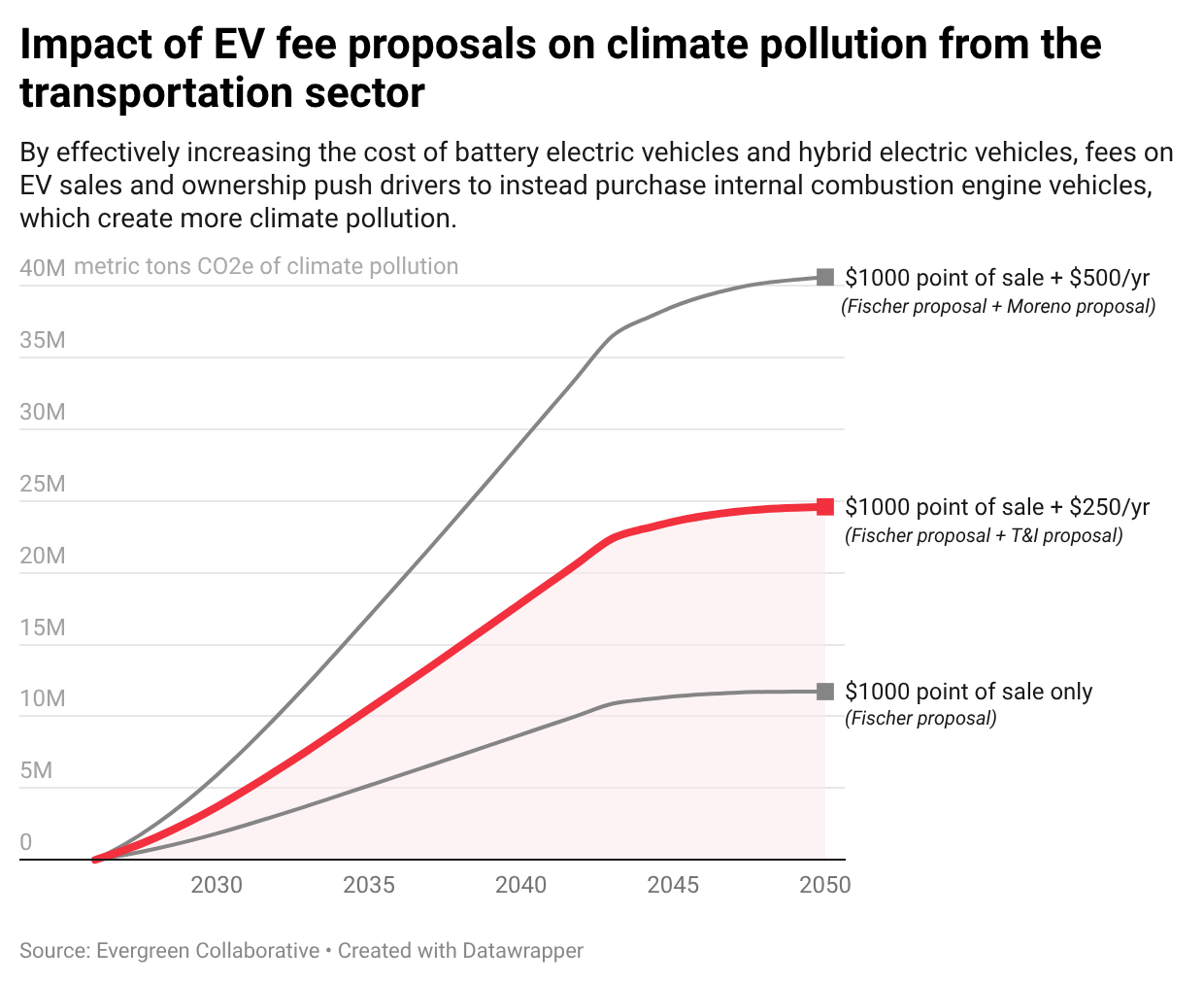
Evergreen analyzed the combined impact of two federal EV fee proposals currently under consideration by Republicans in Congress: a one-time $1,000 point-of-sale fee and a $250 annual registration fee. Together, these policies would make electric vehicles less affordable and gas-powered vehicles more attractive.
From 2027 to 2045, these fees would increase transportation sector climate pollution by a whopping 230 million metric tons (MT) of CO2e—representing a massive surge in climate pollution at precisely the moment the country needs cheaper, cleaner transportation options to meet any meaningful climate goals in our lifetime.
That increase is equivalent to:
- The annual pollution from 61 coal-fired power plants, or
- 54 million additional gas-powered cars on the road for a year.
The modeling also shows that federal EV fees would significantly suppress EV adoption. By 2045, these policies would result in 7.3 million fewer battery electric vehicles and 400,000 fewer hybrid electric vehicles.
In short, any meaningful EV fee—large or small—would push consumers away from EVs and toward gas powered cars, locking in more climate pollution and higher long-term costs. In other words, new federal EV fees would reward pollution and punish consumers who choose cleaner alternatives.
The “Fair Share” Argument Falls Apart
Republicans are pushing new fees on consumers that would burden communities across the country because, they argue, it’s a “fairness issue” and EV drivers should “pay their share.” But once you examine the facts, their claims quickly fall apart:
EV owners already pay significant taxes and fees.
Republicans say EV drivers don’t contribute to maintaining the infrastructure they drive on. That’s simply not true. Forty-one states impose special registration fees on electric vehicles, usually in addition to standard vehicle registration costs, according to the National Conference of State Legislatures. A 2024 Atlas Public Policy analysis found that EV drivers in three dozen states and the District of Columbia already pay more in taxes and fees than drivers of comparable gas powered vehicles.
Gas-powered vehicles impose major public health costs. EVs reduce them.
Gas cars generate air and climate pollution that harm public health and drive real economic costs. Electric vehicles reduce those costs. In effect, EV fees penalize a public good rather than encourage it—and the resulting immense increase in pollution would be detrimental to families and communities across the country. If fairness means paying for the costs a vehicle imposes on society, gas powered vehicles—not EVs—are the ones underpaying.
EV fees do nothing to fix Highway Trust Fund insolvency.
Republicans argue that EV fees are needed to address the Highway Trust Fund (HTF) shortfall. But the HTF deficit is driven by structural factors such as inflation and improving fuel efficiency, not by EV adoption. Even aggressive EV fees would raise only a fraction of the revenue needed to close the gap. There is no EV fee that can meaningfully address the HTF’s massive and growing deficit.
EV Fees Would Be a New Consumer Tax in the Middle of an Affordability Crisis
At the end of the day, Republicans are proposing a new tax on consumers. A recent Credit Karma survey found that nearly half of Americans say their financial situation has worsened over the past year. A POLITICO survey from November 2025 similarly found that nearly half of Americans struggle to afford everyday essentials—including transportation.
That pressure is reflected in the data. The most recent consumer expenditure figures from the U.S. Bureau of Labor Statistics show that transportation is the second-largest household expense, behind only housing, and its share is growing.
By raising the upfront and ongoing costs of electric vehicles, EV fees would make it harder for families to choose cleaner, cheaper-to-operate cars. Instead, they would push consumers towards vehicles that are more expensive to operate and maintain. These policies would increasingly hit middle-class households and used-EV buyers—the very consumers for whom EVs offer the greatest long-term savings.
At a time when Americans are already struggling with rising transportation, utility, housing, and health care costs, Republicans are proposing new consumer taxes that would deepen the affordability crisis and drive a massive surge in pollution across communities nationwide.
Congress Has Better Options
Evergreen’s modeling also identified real opportunities Congress could pursue to cut pollution, improve safety, and lower costs:
- Road safety performance standards that explicitly aim to reduce roadway deaths could prevent approximately 1,000 traffic deaths while reducing climate pollution equivalent to taking 1.5 million gas-powered cars off the road.
- Streamlining transit project delivery could save hundreds of millions annually and years of review time, fund thousands of new electric buses, and expand the transit project pipeline in ways that reduce climate pollution equivalent to taking 800,000 gas powered cars off the road.
- Reauthorizing the NEVI charging program would expand charging access by supporting the construction of tens of thousands of new charging ports, accelerate EV adoption, reduce climate pollution, and strengthen domestic manufacturing.
The findings underscore a simple reality: Congress has real opportunities to build a cleaner, safer, more affordable transportation system. EV fees move the country in the opposite direction.
The Bottom Line
Federal EV fees would massively increase climate pollution, slow EV adoption, and raise costs for families during an affordability crisis. There is simply no version of an EV fee that is fair, effective, or aligned with climate and economic goals.
If Congress is serious about developing a more affordable and accessible transportation system nationwide, it should reject EV fees and focus on policies that expand clean transportation options, improve safety, and deliver real savings for American families.
For more information or to speak with a policy expert, please contact Evergreen Communications Director Seth Nelson at seth@evergreenaction.com.