
Updated: May 21, 2026
65 million Americans across 13 states saw their monthly electricity bills increase by up to 30 percent last year—all because of one shadowy organization standing in the way of low-cost clean energy.
That organization, PJM Interconnection (or just “PJM”), runs the electric grid for Pennsylvania, New Jersey, Maryland, Delaware, Ohio, Tennessee, Virginia, West Virginia, and D.C., and parts of Illinois, Indiana, Kentucky, Michigan, and North Carolina. And it raised energy prices for homes and business owners by up to 30 percent last year alone.
Why? Because PJM is not connecting new energy to the grid fast enough, causing a shortfall in reliable power and skyrocketing annual energy auction prices. That shortfall is largely the fault of PJM and the energy and utility companies that tell it what to do and stand to profit from higher prices.
What Is PJM and Why Should You Be Paying Attention to It?
Regional transmission organizations like PJM are responsible for managing and operating the electrical grid. This entails managing the supply of energy from power plants (“generators”) sold to local utilities, which they then provide to consumers.
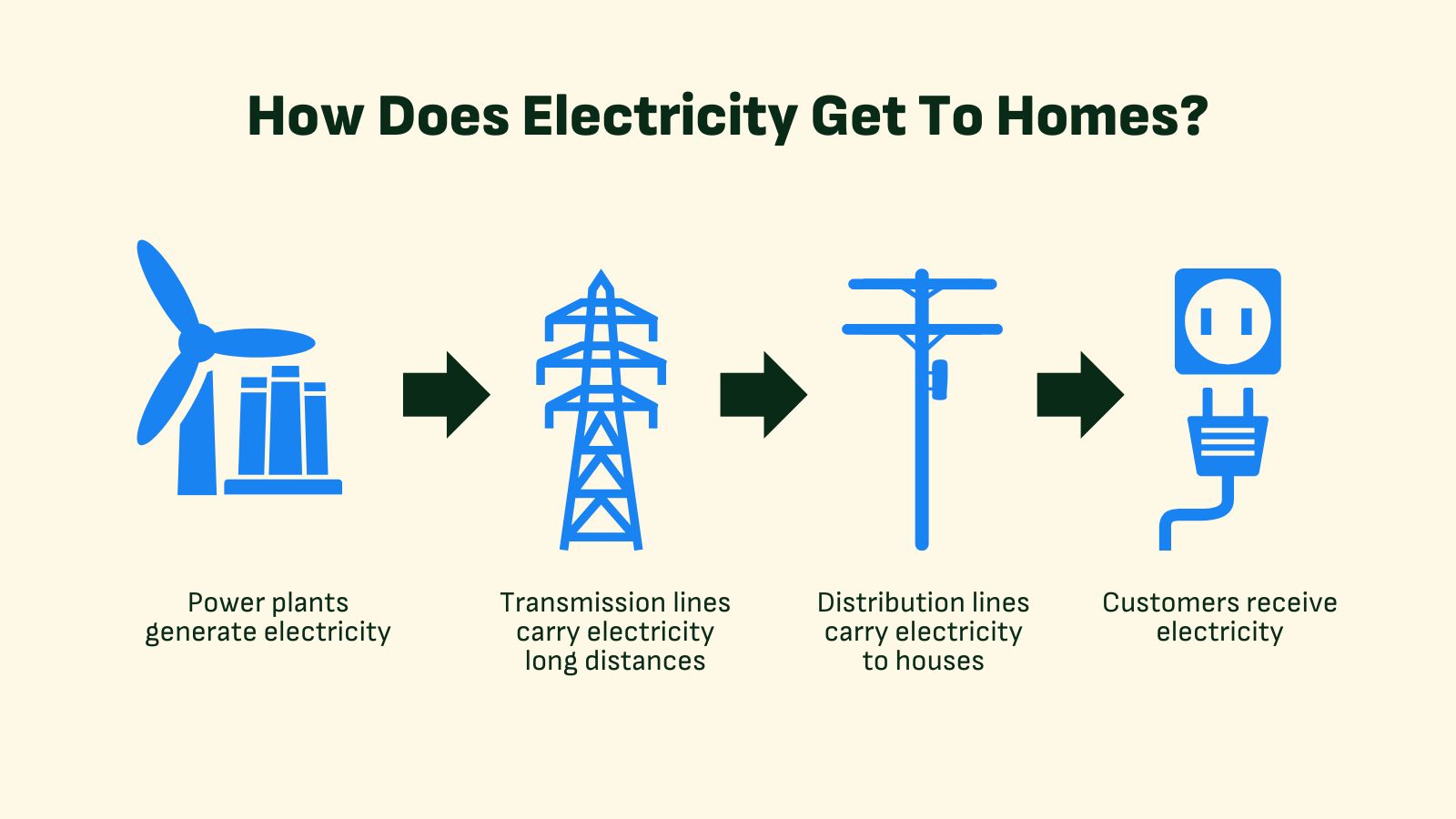
The transmission organizations that run the electric grid hold regular auctions to make sure that enough power plants will be available to provide electricity for subsequent years. These transmission organizations, along with your power company, also manage the construction of large power lines, and decide which proposed power plants get hooked up (“interconnected”) to the grid. Basically, PJM and utilities make many of the decisions that affect how much people in their region pay for their electricity bills.
PJM is the largest such transmission organization, and it controls the electric grid for 65 million Americans—20 percent of the country. PJM is a limited liability company (LLC) that has thousands of voting members—primarily energy companies, utilities, and electricity customers—that have significant influence over how PJM operates.
PJM also holds regular energy auctions to determine which types of energy sources power our homes—whether those are affordable, renewable options or polluting, expensive fossil fuels. This makes PJM an incredibly powerful organization. While PJM makes the energy source decisions, it’s ultimately their customers who end up paying for them. And recently, PJM has been making lousy decisions, like delaying the interconnection of wind and solar energy projects and instead increasing energy costs in the region.
Why Is PJM Raising Power Prices?
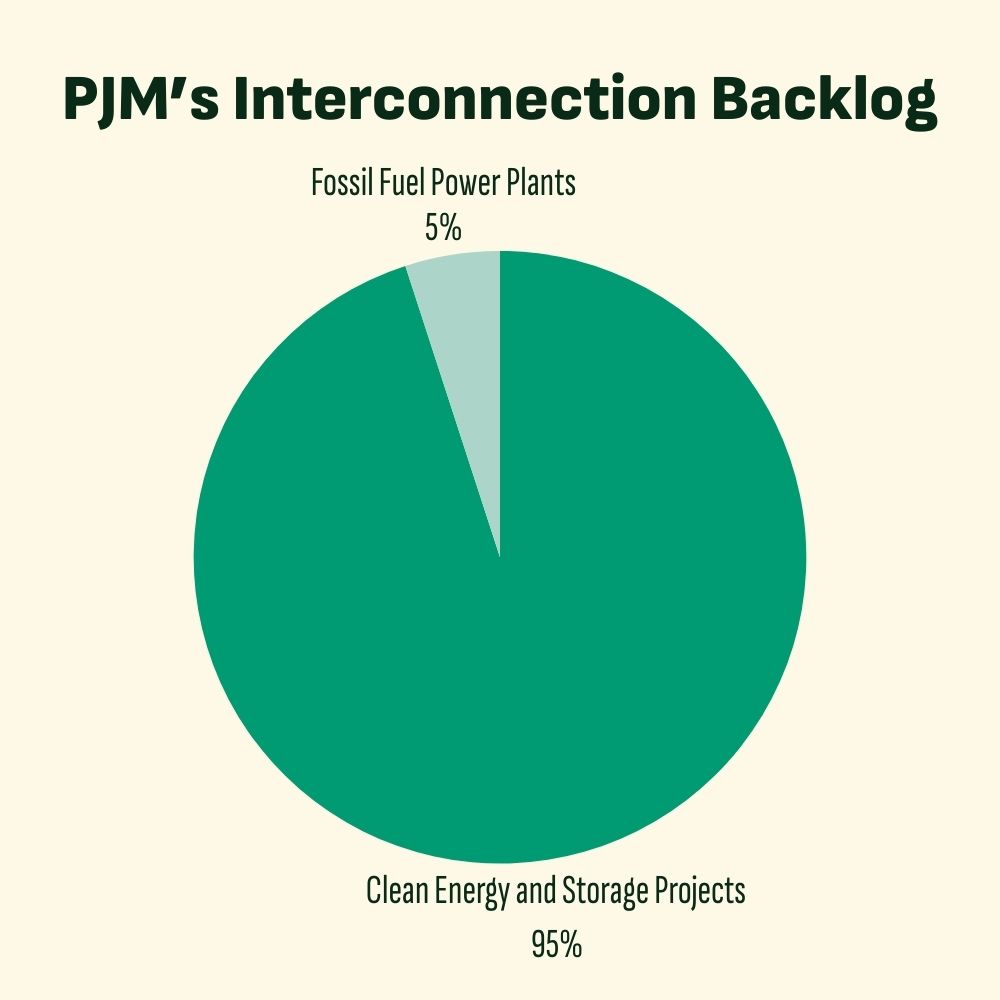
Skyrocketing prices in recent energy auctions resulted from increasing energy demand driven by data center development, unreliable fossil power during extreme weather, and PJM’s inability to approve the construction of new energy projects (95 percent of which are clean energy) to meet this demand.
PJM has long been the worst among its peers when it comes to connecting new energy to the grid and has the worst interconnection backlog in the country.
Over 3,000 projects have been waiting for years to connect to the PJM grid and bring down auction prices, but PJM paused its interconnection queue for nearly four years. Now, PJM is finally reopening its interconnection queue to new generation projects—a long overdue milestone.
However, clearing a backlog is not the same as fixing the structural problems that caused it. PJM has a historically slow interconnection process, with the average project waiting over five years just to get the go-ahead from PJM to start construction.
PJM must fix its interconnection queue and allow these thousands of clean energy projects online.
Many of these projects waiting to be connected—95 percent—are clean energy and energy storage projects. We know that renewable energy sources like solar and wind are the cheapest form of electricity. This means PJM could be addressing its increased demand with affordable clean energy, but instead, ratepayers are paying the consequences of inaction on their electric bills. According to analysis by Synapse Energy Economics, fixing the interconnection queue could save residential ratepayers an average of more than $500 a year through 2040.
PJM decision-making is heavily influenced by its voting members, primarily utility and energy companies that heavily rely on fossil fuel power plants. These companies have a vested interest in protecting their profits from the competition of low-cost clean energy, and they and PJM have worked together to prevent reforms. PJM and these utilities are to blame for this crisis.
PJM Is Prioritizing Unreliable Gas Over Clean Energy
Despite its abysmally slow interconnection process, there is one source of energy PJM is choosing to prioritize—and it’s the expensive, dirtier one: gas. Instead of fixing its queue and allowing cheap clean energy to come online and save customers money, PJM is going all-in on expensive and unreliable fossil fuel technologies.
PJM’s decision-making showcases a conflict of interests: Customers want lower costs, less pollution, and reliable energy, and states with clean energy goals want more renewables online, not less. But PJM is overlooking the interests of millions of Americans in its service territory by choosing to prioritize the dirty and expensive energy, instead.
Gas plants have already led to higher prices. One of the reasons that capacity auction prices are higher in recent years is because of the widespread failure of gas plants in recent winter storms. Gas power plants in the region that were rated previously by PJM as 92-95 percent available fell to 62-79 percent in the most recent auction. Gas plants and pipelines are more likely to fail during extreme weather, whereas wind, solar, and storage are able to provide reliable power in extreme temperatures. We saw this to be the case most notably in Winter Storm Uri in Texas and Winter Storm Elliot in the Midwest and Northeast.
But instead of taking that as a cue to diversify away from gas, PJM is doubling down. PJM recently was granted approval by the federal government to fast-track mostly gas power plants in the queue over the (mostly clean) resources that have been waiting for years to connect to the grid. Gas is far more expensive than clean energy, so fossil energy companies need PJM to put its thumb on the scale to overcome unfavorable economics.
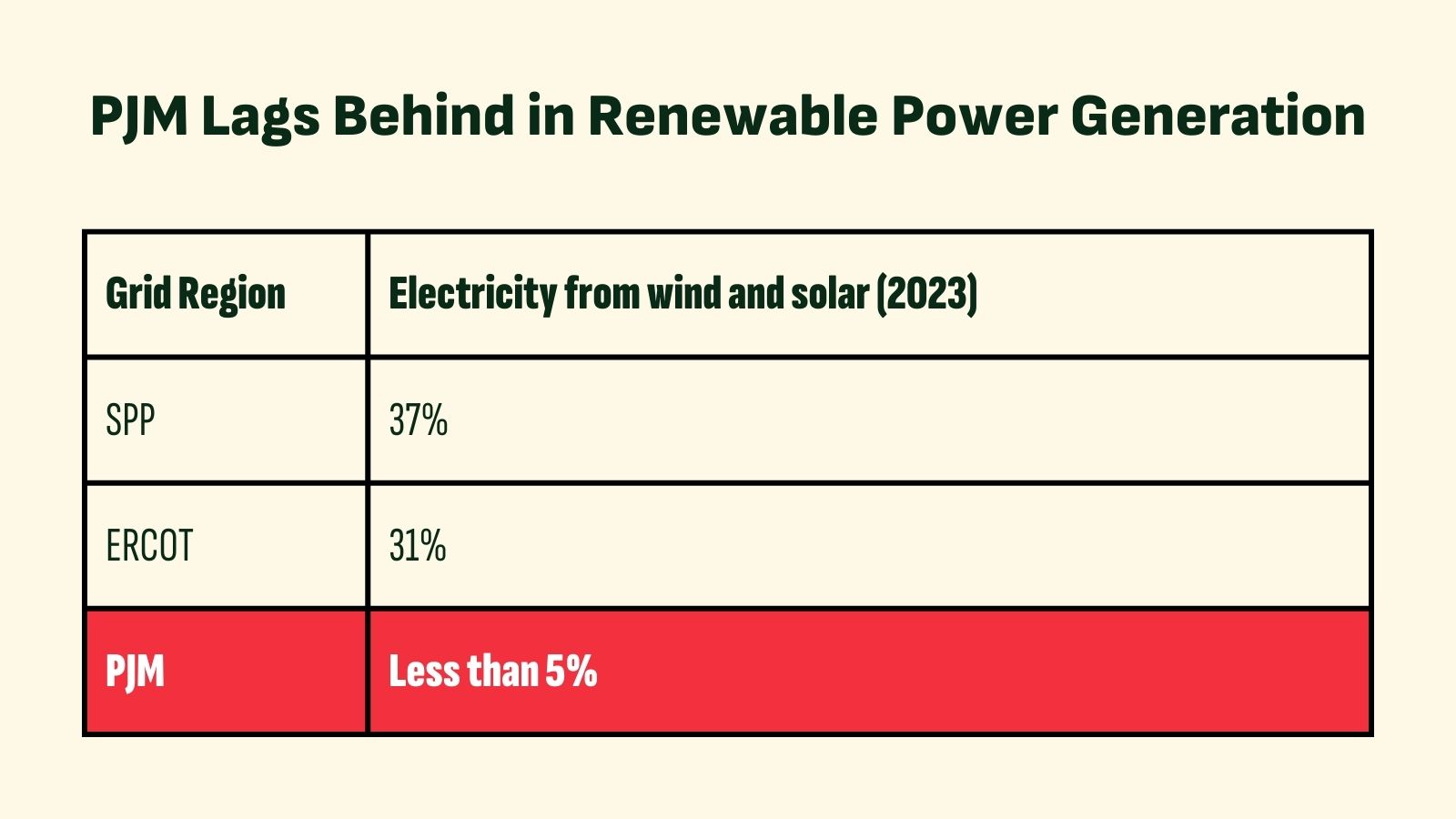
PJM is parroting GOP and fossil fuel talking points in this effort, claiming that relying on renewables would break the grid and that gas is needed for reliability. Meanwhile, back in reality, PJM got less than 5 percent of its electricity from wind and solar in 2023. Other grid regions like SPP and ERCOT managed a grid with 37 percent and 31 percent wind and solar energy, respectively, without issue in 2023. PJM’s claims would be laughable if they weren’t so deadly serious for our climate and for families’ budgets. Rather than fixing the jammed queue itself, PJM is focused instead on letting gas plants cut in line.
What Can Be Done About It?
A deal reached by PJM state governors will cap prices for the next two years and require big tech companies to pay for additional supply needed to power data centers. This is a meaningful near-term step, but it doesn’t solve the structural problems that have driven prices higher—and costs will continue to rise until PJM solves the underlying problems with its interconnection queue.
To make the grid work for the long term and protect consumers from rising costs, PJM must:
- Meet the faster interconnection timelines required by FERC Order No. 2023;
- Deploy advanced software and automation to accelerate study timelines;
- Proactively build transmission and reform how costs are allocated for grid upgrades during interconnection; and
- Reform the energy-only interconnection pathway to get power online more quickly.
PJM has recognized that this situation is untenable and is asking FERC to approve changes to its Surplus Interconnection Service process, which allows new projects to take advantage of existing interconnection agreements that aren’t using their full capacity. FERC should approve this request, while rejecting other asks such as PJM’s gas fast-track proposal (the “Reliability Resource Initiative”) that would violate FERC fairness and non-discrimination doctrines.
States can also take steps to keep down energy bills and ensure PJM works to keep costs down. Other states can follow the lead of Pennsylvania and consider leaving PJM unless PJM truly works to reform interconnection and prevent future price hikes.
States can also soften the blow of price hikes by increasing annual energy efficiency targets for utilities through their Public Utility Commissions, implementing cap-and-invest programs like RGGI or PACER in Pennsylvania that return money directly to ratepayers, or limiting utility’s guaranteed rate of return while utilities are using their influence within PJM to resist changes that would have prevented these rate hikes.
States can also increase PJM and utility accountability by requiring PJM to provide voting reports of key PJM committees to increase transparency and sunshine PJM actions to the public.
Additionally, states should work to streamline projects and technologies that would prevent future rate hikes. State legislatures can streamline siting and permitting for clean energy and transmission projects so that energy can be added to the grid more quickly. They can also require utilities to deploy grid-enhancing technologies and virtual power plants that get more capacity out of the existing transmission grid and demand-side resources.
The Bottom Line
The cause of these massive rate hikes can sound complicated. But the bottom line is that low-cost clean energy is the solution to bring down sky-high electricity bills for millions of Americans. We need more of it, and we need it now. PJM’s decision to open its interconnection queue is a step in the right direction, but reopening the queue is not the same as fixing it. Only by allowing cheap solar, wind, and storage projects to come online quickly will we prevent future cost increases. PJM’s inaction has already caused years of unnecessarily high costs for working families—and only structural reform will deliver lasting relief.